Watching "A Transgender Woman on the Internet, Crying" 5 Times
Spoiler note: This post discusses specific themes, character dynamics, and a few scenes from A Transgender Woman on the Internet, Crying. It is more interested in the show’s ideas but may affect your enjoyment of the show compared to going in blind.
I watched A Transgender Woman on the Internet, Crying five times.
That is probably the clearest review I can give it, but it is also not quite enough. After the first night I left thinking almost immediately "fuck it, I’m buying four more tickets so I can make every remaining show I’m able to make".
At first that was easy to explain. I loved the music, the humor and the staging. The hyperpop energy, the internet language and the speed of it all landed for me immediately. It was sharp, funny, and musically strong.
The deeper answer is that each time I went back the show opened into something else. The first time it felt exciting and validating. The second time it felt sadder. The third time it got bigger. The fourth time it got tangled up with my own anxiety. The fifth time it stopped feeling like just a show I admired and started feeling like proof that some other version of life might still be possible.
As a production
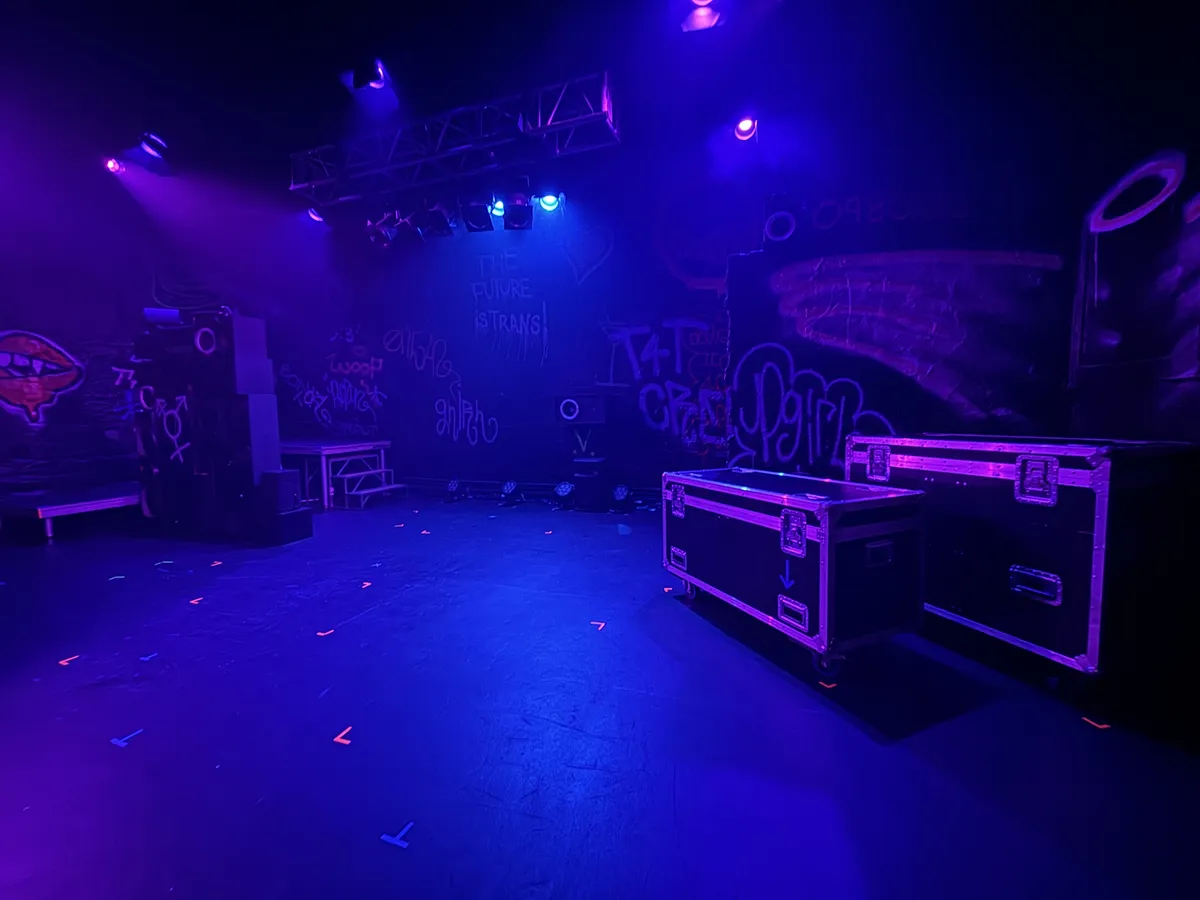
Before the show had even properly started it already had me. The graffiti-covered set and the hyperpop playing as people filed in set the tone immediately.
The production is also just smart. The lighting does a huge amount of work. The same set can read as one whole environment and then with one part isolated suddenly become somewhere else entirely. The phone and online communication are staged well too. Streams, calls and digital interaction all feel built into the show rather than awkwardly explained.
And the songs are excellent. That was one of the simplest reasons I kept going back. Even once I started having more complicated thoughts about the show the basic fact remained that I really liked listening to it.
The room
Part of what I was going back for was the room itself.
The lighting was dim enough that I was not hyper-aware of how I looked. The expectations on me as an audience member felt clear. The whole atmosphere felt welcoming to trans people in a way that made me relax almost immediately.
That is not always how queer spaces have felt to me. I had been to a drag show before and spent a lot of it feeling on edge, like simply being there was some kind of personal risk. This did not feel like that. It felt safer, smaller, more intimate. More obviously built for trans people rather than merely open to them.
That matters because part of what I kept returning to was the feeling of sitting somewhere I did not have to justify my existence as much.
First viewing: recognition
The first time was the cleanest. I loved it immediately.
A lot of what I normally only think or half-say suddenly existed in front of me without apology. Not passing, being non-binary and transfemme, different transition goals, the pressure to be seen as valid. Even the Grindr material hit something very recognisable for me especially the ugly overlap between sexualisation and affirmation where part of you can still feel seen by something that is also creepy, flattening, or wrong.
The idea of the “perfect trans girl” landed immediately too. On that first viewing I understood it mainly as a critique of passing politics, of palatability, of becoming the kind of trans woman cis people can tolerate because she is polished, legible and easy to explain.
The non-binary transfemme representation mattered more to me than I expected. Often I feel like the only person on earth who identifies that way, still wants to take significant steps in transition and also likes girls. When you do not see that combination reflected back at you it becomes easy to think maybe you are doing something wrong. Maybe you are just embarrassing.
Most of my friends are cis, mostly straight, mostly men. When transness comes up in my actual life it often feels like I have to carve out just enough room for it. Enough to say something real, not enough to make the atmosphere strange. This show did not feel like that. It felt like it was naming things completely.
That alone would have been enough to make me love it.
And when I left that first show, I did what people do when they know they have found something rare. I bought more time with it.
Second viewing: the “perfect trans girl”
The second time, my reading of the show started shifting.
By then the “perfect trans girl” material already felt less simple. I started seeing more of the shame sitting underneath that character. More fear, more of the desperate logic of trying to become safe by becoming understandable. It stopped feeling like a clean divide between the right trans politics and the wrong ones. It started feeling more like a story about what different people do when they are forced to survive under the same hostile standard.
Some people get moulded by cis expectations and try to become the perfect trans girl because that seems like the safest path. Some people do not fit those expectations neatly and end up having to fight harder for their experience to be treated as valid. One of the ugliest things the show understands is that the people most shaped by those expectations can end up reinforcing them against other trans people.
That is part of what made the scene where trans people cancel another trans character online as transphobic so important to me. It complicates any easy reading where cis society is the only source of pressure and trans people are simply united on the other side. The show knows that trans people can police each other too. It also knows that this policing does not come from nowhere. People can think they are defending trans people and still become cruel, punitive and flattening in the way they do it.
What I took from that was not that one side was correct. It was that the standard itself was doing the damage.
Third viewing: being read
By the third viewing, one phrase had started sticking in my head:
being read versus being understood.
That is the clearest way I can explain what the internet side of the show was doing for me.
Online you can present yourself more deliberately. You can choose your words, your photos, your communities and the parts of yourself you highlight. You are not always dealing as directly with people who knew you before transition or with the immediate weight of the cis gaze in a physical room. That can make understanding feel more possible online than offline.
But online also makes misreading scale.
You can present yourself more honestly and still get flattened into a trope. You can be sexualised and get a gross little flicker of affirmation from it. You can try to explain yourself and find that people prefer the easier version of you.
One of the sharpest examples of that in the show is the way one character gets categorised as a “heteroflexible boy toy.” That label does a huge amount of flattening in very little space. It turns a person into a role in someone else’s story. It rewrites desire, gender, and subjectivity all at once into something legible, jokey, and consumable.
That stayed with me because it felt very close to a logic I recognise in myself.
Not the exact label obviously, but the compromise underneath it.
Maybe it is fine if people call me a femboy. Maybe that is close enough. Maybe that gives me enough room to wear what I want, to be softer, to be prettier, to move through the world in a way that feels less suffocating. Maybe it does not matter if they do not acknowledge that I actually want to be a woman. Maybe I can keep that part private and still take what I can get.
That is not the same as being understood. It is being read in a way that hurts less than some of the alternatives.
And that is part of what the show got right for me: compromise can feel survivable while still being a loss.
This was also the viewing where the followers started to feel bigger than literal followers. I had started reading them as a representation of society at large speaking through followers. Mostly cis people rewarding a whole package rather than one trait: passing, palatability, straight-coded femininity, respectability, and being easy to understand from the outside.
At the same time the show leaves room for another version of online life too: smaller forms of trans connection that feel less like audience and more like actual understanding. Friendship where you do not have to justify your existence as much. Friendship where you are not immediately being converted into a role.
That distinction mattered to me a lot.
Fourth viewing: anxiety
Not every viewing deepened the show in a satisfying way.
By the fourth show, I was so aware of myself being there that I could barely enjoy it properly. I was sitting at the back and every time an actor looked off into the distance it felt like they were somehow looking at me. I know that sounds irrational, it was irrational but it changed the experience completely. I stopped watching the show and started watching myself watch it.
Part of what made that so uncomfortable was the fear of how I might be seen for coming back so many times. I started worrying that the cast might think I had some kind of parasocial attachment to the show or that I was being greedy by taking up space at something other people wanted to see. Rationally I knew I was just behaving like an audience member but emotionally it felt much harder to believe that.
That ended up mattering too.
It stopped being just about a brilliant production I loved. It became tangled up with embarrassment, scarcity, anxiety and the fear of wanting something too much. Even something good can get distorted once you become too conscious of yourself in relation to it.
That is part of the honest version of this story. I did not simply love it five times in a row, at one point I got too in my own head to digest it properly at all.
Fifth viewing: what it opened up
The fifth viewing was different. I took Valium before going and actually enjoyed it again.
That was also the viewing where some of the family material hit me hardest. One character talking about conservative parents and constant misgendering and the way the other characters supported her was incredibly moving. It made me want that kind of community more than anything else.
It also left me with a simpler thought than I usually allow myself: who gives a shit how I look in a skirt if it makes me happy?
That sounds small. It did not feel small.
A lot of what the show stirred up was already there. It did not invent it. It just made it harder to ignore.
It also made my longing for trans friendship more obvious. Not vague community in the abstract but friendship with people who understand certain things without me having to soften or translate them. Friendship where my existence is not always slightly up for debate. Friendship where I do not have to wonder which box someone has silently put me in.
That part hit even harder because all of my close friends are cis-het. I care about them but it often feels like I have to delicately carve out room for conversations about transness. Sometimes it was nice to go with different friends and point out the little in-jokes or references. Sometimes it was nice to let the show explain something by proxy that I would otherwise have had to explain myself. While waiting for one show, a friend misgendered me while we were in line, and later the show touched on the way non-binary transfemme people can get assumed to be trans women in ways that miss something important. It was a relief not to have to carry all of that explanation alone.
The family material got to me too. One character having non-accepting family and another seeming to have something more accepting or at least more workable made me think harder about my own family secrecy. I know it would go badly but it has become clearer to me that keeping everything in the dark is not neutral. It is one of the biggest things limiting what more visible steps in my transition can even feel possible.
After the final show I thanked one of the actors. I was awkward (as I usually am in social situations) but it still gave me some relief. It reminded me that a lot of the anxiety had been mine, not something actually coming from outside.
Conclusion
The simple answer is that I watched A Transgender Woman on the Internet, Crying five times because I thought it was excellent.
That answer is true, but incomplete.
I watched it because after the first viewing I wanted every remaining chance I could get to experience it again. I watched it because the music and performances were good enough to justify that impulse. I watched it because each return made the show feel deeper, sadder, more complicated and more important. I watched it because for a few hours at a time I could sit in a room where my version of transness still counted.
That feeling did not survive intact once I went back to normal life. It lasted a few hours, sometimes into the next day and then ordinary life closed back over it again.
But it was real while it lasted.
And that has made some things harder to ignore. The desire for trans friendship. The desire to dress more freely. The frustration of family secrecy. The possibility that I might be happier if I stopped treating every step toward being myself like something I need to defend in advance.
So yes, I watched it five times because I thought it was excellent.
I also watched it five times because for a little while it made a different life feel close enough to touch.